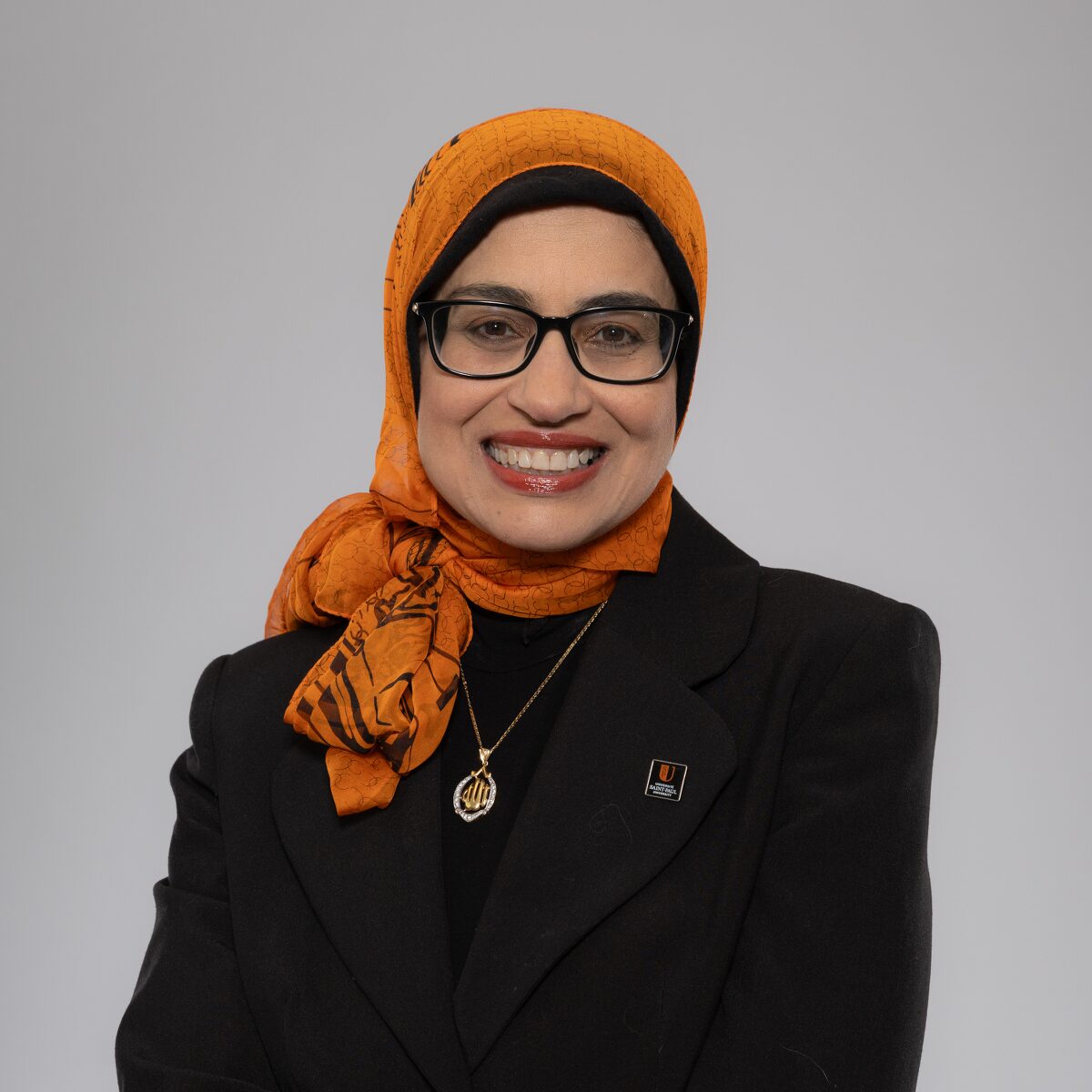
This month, we are proud to feature Dr. Aliaa Dakroury, Full Professor in the School of Social Communication, as our researcher of the month.
Her research explores communication rights—not just access to information, but the ability to express oneself, participate in public dialogue, and be heard—and how these rights are shaped by political, economic, and global power structures. It also explores how communication rights can expand understandings of citizenship, civic engagement, and public discourse beyond traditional notions of freedom of expression, in Canada and internationally.
Below, Aliaa shares what drew her to this field of research, what she wishes more people understood about it, and how you can learn more.
What inspired you to choose this field of research?
Since a young age, I have been fascinated by questions of voice, power, and participation: Who is allowed to speak, who is silenced, and who can successfully claim the right to be heard? This curiosity led me to study media and communication and, over the course of my academic career, to elaborate on the concept of the right to communicate.
What are 3 things you wish people knew about your field of research?
- Communication is more than access to information.
Many people think communication is simply about receiving information through the news, social media, or the internet. In reality, communication also happens through culture, symbols, and everyday practices. For example, wearing a traditional garment, displaying a cultural symbol, or sharing a meal during a religious celebration communicates identity, values, and belonging. Communication rights therefore involve not only access to information, but also the ability to express oneself and participate in cultural and social life. - Communication is deeply connected to power.
Not everyone has the same opportunity to speak or be heard. Political, economic, cultural, and technological factors often determine whose voices are amplified and whose are marginalized. For example, large media organizations can shape social debates in ways that grassroots groups often cannot, while certain communities may struggle to gain media attention even when issues directly affect their lives. - Communication rights are essential to democracy and social justice.
Our ability to communicate affects much more than media; it influences citizenship, education, public participation, and social change. For example, social movements rely on people being able to organize, share information, and engage in public debate. Without these meaningful opportunities to communicate, participation in democratic life becomes limited.
Can you recommend any resources for those who want to learn more about your field of research?
If you’re interested in exploring some of the concepts in my research, here are some of my favourite movies that demonstrate the power of communication in its many dimensions:
- Mandela: Long Walk to Freedom (2013): This movie talks about Mandela’s journey and demonstrates how the ability to express one’s beliefs and communicate one’s vision can inspire change and advance human rights.
- Hidden Figures (2016): One of my very favourite movies ever! It reminds us that inclusive communication ensures that all people, regardless of background, have the opportunity to contribute, be recognized, and be heard (MUST SEE!).
- The Wild Robot (2024): This one shows how communication extends beyond words, showing how listening, empathy, and understanding can foster belonging and meaningful participation in a community (warning: a box of Kleenex is needed!)
If this sparks your curiosity, you are always welcome to attend one of my classes, read my publications, or simply stop by for a conversation (and coffee). After all, communication begins with dialogue!
Where can people find some of your more recent research?
Who gets to speak? Who gets heard? And who is left out of the conversation? The publications below examine these enduring questions through the lens of the right to communicate. Together, they represent some of my recent work on the subject.
- Dakroury, A. (2026). Two eras, one battle: The tale for the right to communicate in the Arab world. Middle East Journal of Culture and Communication, 18(3-4), 306-333. https://doi.org/10.1163/18739865-bja10006
- Dakroury, A. (2026). Communication rights, power and pro-Gaza campus activism. Work, Organisation, Labour & Globalisation, 20(2), 272-287. https://doi.org/10.13169/workorgalaboglob.20.2.0007
- Dakroury, A. (2025). Beyond a mega sports event capture, Qatar World Cup 2022: Dribbling between media narratives. Journal of Sports Media, 19(2), 163-186. https://doi.org/10.1353/jsm.2024.a973892
- Dakroury, A. (2024). The instant world report: Canada’s role in shaping the right to communicate. Palgrave Macmillan. https://doi.org/10.1007/978-3-031-68172-1
Thank you, Aliaa, for sharing your insights on the vital importance of communication!