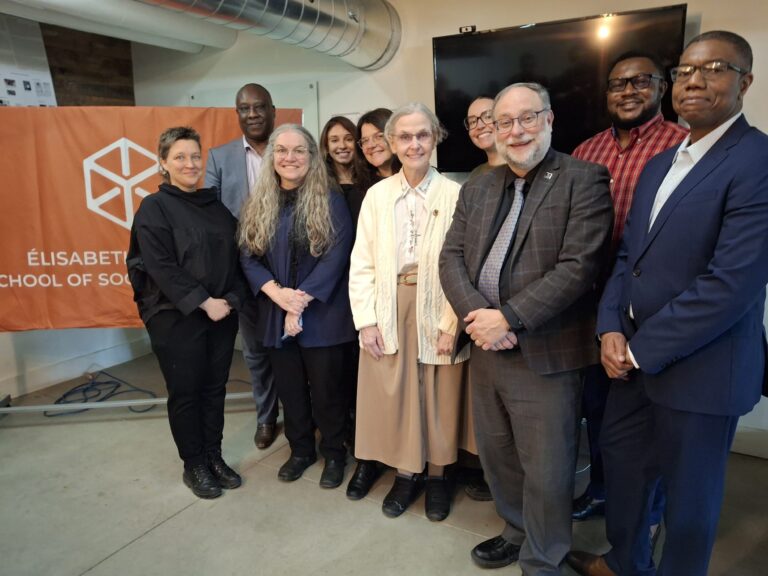
This fall, the Élisabeth-Bruyère School of Social Innovation will launch Roadmaps for Changing the World, a collective book that captures nearly a decade of critical reflection, pedagogical experimentation, and community-rooted practice. Written by the school’s core faculty, the book offers concrete tools, strategies, and insights for those committed to building a more just and equitable world. More than a retrospective, it serves as a guide for educators, activists, students, and changemakers navigating the complexities of transformation in our time.
Founded in 2016, the Élisabeth-Bruyère School of Social Innovation is the first institution in Canada dedicated to social innovation across all three academic cycles—bachelor’s, master’s, and doctoral programs. The school has positioned itself as a visionary space where students, professionals, entrepreneurs, and activists come together to explore the possibilities of social change, spark creativity, and develop solutions that respond to the real needs of communities.
Alongside its academic programming, the school has cultivated a unique bilingual ecosystem that includes a research center—the Centre for Research on Social Innovations and Transformations (CRITS)—and a nonprofit hub, the Social Innovation Workshop (commonly known as the Atelier). Inspired by coworking spaces, third places, innovation labs, and creative incubators, the Atelier functions as a lively, collaborative environment where theory meets practice. It supports the launch of social enterprises, community organizations, and mission-driven initiatives while fostering meaningful connections between academia and local realities.
From the beginning, the school’s founders were confronted with essential questions: What does it take to change the world? What tools, methods, and strategies are needed to make sense of social realities, challenge structural injustice, and initiate inclusive and democratic organizations? How can social sciences, management studies, activist knowledge, and collective learning converge to support grassroots movements, cooperatives, and community institutions? And, more fundamentally: What is social innovation?
These questions are at the heart of Roadmaps for Changing the World, which distills the faculty’s ongoing inquiry into a practical and reflective resource. The book documents the school’s evolution while engaging critically with the very notion of social innovation. It highlights the importance of praxis, collaboration, and collective learning as foundational elements of both the school’s pedagogy and its broader mission.
As an educational experiment in itself, the school has continuously adapted to major social and institutional disruptions—from the COVID-19 pandemic to the ongoing pressures of neoliberalism within higher education. Originally designed around immersive, experiential, in-person block courses, the school’s programs have remained committed to critical pedagogy while also responding to the evolving needs and experiences of students. These adaptations reflect a deep engagement with learning as a dynamic, relational, and community-embedded process.
The school’s faculty has also expanded over the years, bringing in new voices and perspectives rooted in community-based research, transformative scholarship, and emancipatory methodologies. Despite a diversity of backgrounds, disciplines, and lived experiences, the faculty shares a collective commitment to social transformation and a recognition of the power that emerges from working across difference. This ethos informs both their teaching and their collaborative writing process.
The forthcoming book is both a narrative and a roadmap. It offers frameworks, examples, and actionable insights designed to support social change efforts—without claiming to offer one-size-fits-all solutions. Rather, it emphasizes practices that already make a difference in people’s lives and suggests ways to deepen and scale these efforts. The book centers accessibility and practicality, making it a valuable resource for those confronting complex crises, from ecological collapse to rising authoritarianism.
In line with the school’s broader philosophy, Roadmaps for Changing the World affirms that naming systems of oppression—colonialism, capitalism, white supremacy, cisheteropatriarchy, ableism—is only the starting point. The real challenge lies in nurturing and sustaining the alternatives. The book invites readers to not only reflect, but also to act, to build infrastructure and relationships that make meaningful and durable change possible.
Whether read by educators, community organizers, researchers, students, or social movement leaders, Roadmaps for Changing the World offers a timely and grounded resource for those seeking to imagine and co-create better futures. It is both an invitation and a toolkit: to get uncomfortable, to learn and unlearn, and to walk together toward transformative action in a moment that demands nothing less.